
Orange County Court Records After a Jail Arrest
When someone is arrested and booked in Orange County, a prosecutor reviews the case and files the charges that open a court record. The arrest itself is logged at the jail. The court record, with the formal charges, hearings, and disposition, is created and held by the Orange County Clerk of Courts. That is why a booking charge on the jail roster and a filed charge in the court file are not always the same thing.
The booking side and the court side answer different questions. For the roster, custody status, and booking detail, the jail inmate records page covers the lookup, and booking photos are handled on the jail roster mugshots page. The court record itself is the prosecutor's filed charges tracked through the case, which is what this page walks through from the arrest forward.
How to Find Orange County Court Records After an Arrest
Orange County court records sit in the Clerk of Courts case search, the my eClerk portal. It lets you search by defendant name or case number and read the charges, the docket, and the disposition once a case is filed and public. Booking and arrest detail still lives on the jail roster, so the two systems work together.
The Clerk's my eClerk case search opens to a criteria form with name, case number, citation number, and date fields.
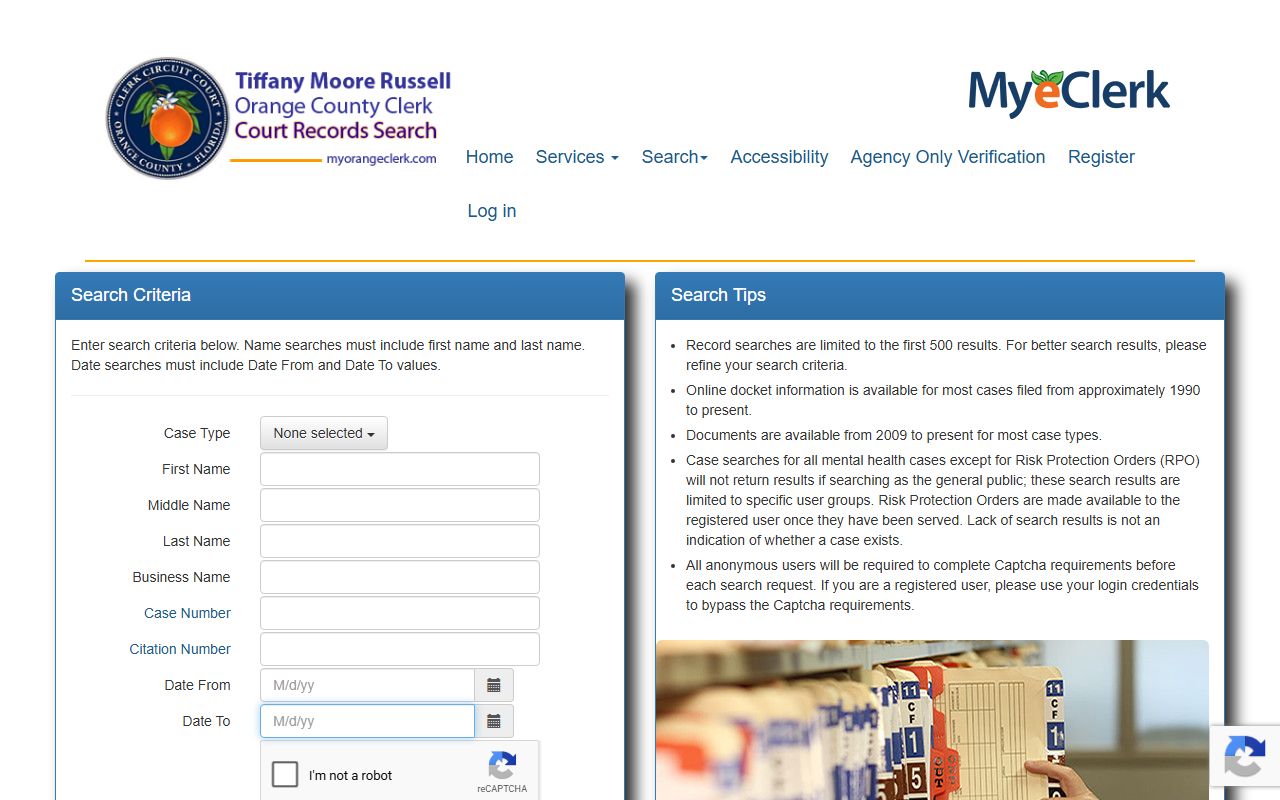
Anonymous users complete a CAPTCHA before each search, while registered users can skip it by signing in.
- Open the my eClerk case search portal.
- Search by the defendant's first and last name, or by case number.
- Open the case and read the charge list and the docket entries.
- Check each charge's code, level, and current status.
| Field Label | Type | Required | Notes |
|---|---|---|---|
| First / Last Name | Text | Both required for a name search | Max 50 characters each; a name search must include first and last name. |
| Case Number | Text | No | Formats shown: YYYY-XX-999999-A-O or YYYY-XX-999999-O. |
| Citation Number | Text | No | Format shown: X1XXXXX. |
| Date From / Date To | Date | Both required for a date search | A date search must include both values. |
| CAPTCHA | reCAPTCHA | Yes for anonymous users | Registered users sign in to skip it. |
Online dockets reach back to roughly 1990, documents to 2009, and a single search returns up to 500 results, so a common name needs date or case-number filters to narrow.
Who Files the Charges After an Arrest
The charges in a court record come from the State Attorney, not the arresting officer. Orange County sits in the Ninth Judicial Circuit, which serves Orange and Osceola counties, and the current State Attorney is Monique H. Worrell. Her office reviews each arrest and decides whether to file, amend, or decline the charges, which is the step that turns an arrest into a court case.
The Ninth Judicial Circuit State Attorney's office lists its locations and explains how prosecutors, victim advocates, and support teams handle cases.

The Orange County office is at 415 North Orange Avenue in Orlando, reachable at 407-836-2400, and it also keeps an office at the Booking and Release Center.
How Charges Get Filed After an Arrest: Complaint, Information, and Indictment
Walk from the arrest forward. Booking happens at the jail, and then the court record begins when the prosecutor files a charging document. Florida uses three main types, and which one appears depends on how serious the offense is and how the case is brought.
| Complaint | Information | Indictment | |
|---|---|---|---|
| Filed By | Officer / Prosecutor | State Attorney | Grand Jury |
| Common For | Misdemeanors and initial charges | Many felonies | Capital and serious felonies |
| Starts | The case | The case | The case |
The booking charge that shows on the jail roster is the arrest charge. The charge in the court file is what the State Attorney actually filed, which can be different.
Charge Status and What It Means
Charges change as a case moves through court. A count can be amended, reduced, added, declined, or dismissed, and the court record tracks each step. Because the booking charge and the filed charge can differ, the status in my eClerk is the reliable one for the court case.
| Status | What It Means |
|---|---|
| Pending | An active, unresolved charge still moving through court. |
| Filed | The prosecutor has filed a formal charge. |
| Amended / Reduced | The charge was changed or lowered after filing. |
| Dismissed | The court or prosecutor ended the charge. |
| Nolle Prosequi | The prosecutor declined or abandoned the prosecution. |
Note: a court record that returns no result is not proof a case never existed, since some case types are restricted from public search.
Bond and Release After an Arrest
Bond is set at first appearance, the hearing where a judge tells the person the charge and the bond status. To post bond in Orange County, a person can use a licensed bonding company or bring the full exact amount to the public windows in the Booking and Release Center lobby, which are open 24 hours. The county brochure says payment is by money order, traveler's check, or certified or cashier's check made payable to the Clerk of the Courts, with no personal checks and no cash for bond.
| Bond Type | How It Works |
|---|---|
| Cash Bond | The full bond amount is paid directly for release. |
| Surety Bond | A licensed bail bond agent posts the bond for a fee. |
| PR / Own Recognizance | Release on a written promise and court conditions, without posting the full cash amount. |
| No-Bond Hold | No bond is available until a court action or a hold is cleared. |
A posted bond may not free someone if a detainer, an immigration hold, or another agency's custody issue is still open.
Warrants That Lead to an Arrest
An outstanding warrant can send a person to the Booking and Release Center, where the booking starts the same path toward a court record. The Orange County Sheriff's Office does not confirm warrants to the public through its own warrants unit, so it points people to CrimeLine, the Clerk of Court, or in-person inquiry with identification at Orange County Corrections, 3723 Vision Boulevard, Orlando. The statewide FDLE wanted-person search is another option, though FDLE warns its result alone is not confirmation of an active warrant. The OCSO wanted page links these official channels.
Charges vs. Convictions
Being arrested and charged is not the same as being convicted. A charge is an accusation. A conviction is the result of a plea or a verdict. The court record shows both stages, and confusing them is a common mistake.
| Charge | Conviction | |
|---|---|---|
| Stage | Accusation | Verdict or plea |
| Burden of Proof | Probable cause | Beyond a reasonable doubt |
| Public Record | Yes | Yes |
Sealed vs. Expunged Arrest Records
Florida lets some people clear an arrest record after a dismissal or an eligible disposition. Sealing hides the record from public view, while expunction, set out in Fla. Stat. 943.0585, treats an eligible record as if it were destroyed. The Florida Department of Law Enforcement reviews eligibility and runs the seal-and-expunge process.
| Sealed | Expunged | |
|---|---|---|
| Visibility | Hidden from public view | Destroyed or treated as never existed |
| Law Enforcement | Limited access remains | Very limited access |
| Eligibility | Set by Florida law, reviewed by FDLE | Set by Florida law, reviewed by FDLE |
Background Check Considerations
Court records after an arrest are public, but using them for hiring, housing, or credit decisions is governed by federal law. A proper background check for those decisions must come from a consumer reporting agency that follows the Fair Credit Reporting Act, not from a casual record search.
Important: This is not a consumer reporting agency under the FCRA, and its information may not be used to decide employment, housing, credit, or insurance.
Court Document Requests and Fees
Many court records can be read for free through my eClerk, and the portal allows non-certified printing of much of what is online. When a document is not posted, the Clerk can process a request online, by mail, or in person, and the office notes that processing may take up to 10 business days. The records that follow an arrest often include the arrest affidavit, the charging document, the disposition, and any judgment or sentence.
| Document | What It Is |
|---|---|
| Arrest Affidavit | The officer's sworn account supporting the arrest. |
| Complaint / Information | The charging document that opens the case. |
| Disposition | The recorded outcome of each charge. |
| Judgment / Sentence | The court's final judgment and any sentence imposed. |
Copy and certification fees apply to documents the Clerk produces, and certified copies cost more than plain copies. Confirm the current fee with the Clerk before ordering, since rates are set by the office and can change.
Note: a free online view is enough for most questions, but a certified copy is what courts and agencies usually require for official use.
Restricted Court Records After an Arrest in Orange County
Not every court record after an arrest is open to the public. Juvenile cases, sealed and expunged charges, and most mental-health cases other than risk-protection matters do not return public results in my eClerk. An ongoing investigation can also keep records out of view for a time. A missing search result, then, is never proof that a case does not exist.